


Course Overview
PHY 116 Physical Science — Introduction to Meteorology
Fall 2026 • Taught in person on campus
Monday and Wednesday
1:40–2:55 p.m. or 3:05–4:20 p.m.
This course fulfills three credits of the General Education science requirement.
Instructor Information
Professor Richard Hoffman
Meteorologist and Farmingdale State College instructor
Phone: 516-393-1774
Email: hoffmard@farmingdale.edu and richard.hoffman@farmingdale.edu
Course website: richhoffmanclass.com
Office Hours and Meetings
There are no regularly scheduled office hours. Students may contact Professor Hoffman by phone or email to arrange a meeting before class, after class, or at another agreed-upon time on campus.
Grading and Course Requirements
Grade Distribution
- Four semester exams: 60%
- Final exam: 30%
- Homework, class participation, discussions, and attendance: 10%
There are four exams during the semester plus a cumulative final exam, for a total of five tests.
Exam Rules
- The lowest test grade is not dropped.
- There are no routine makeup exams.
- If a student misses an exam, the final exam grade will replace the missed exam grade.
- Exams are given during the student's scheduled class period.
- Each exam contains 50 questions.
- No extra credit is offered.
Farmingdale State Grading Scale
| Score | Grade | Quality Points | Description |
|---|---|---|---|
| 93–100 | A | 4.00 | Excellent |
| 90–92 | A− | 3.67 | |
| 87–89 | B+ | 3.33 | |
| 83–86 | B | 3.00 | Good |
| 80–82 | B− | 2.67 | |
| 77–79 | C+ | 2.33 | |
| 73–76 | C | 2.00 | Satisfactory |
| 70–72 | C− | 1.67 | |
| 67–69 | D+ | 1.33 | |
| 60–66 | D | 1.00 | Minimum passing |
| 0–59 | F | 0.00 | Failure |
Important Exam Policy
If you miss one semester exam, your final exam grade will replace that missed exam grade.
A grade of zero will be assigned for cheating. Academic integrity rules apply to all examinations and coursework.
Final Examination Information
The final exam covers Chapters 1–11, contains 50 questions, and is worth 30% of the course grade. It will be similar in format to the first four exams.
| Class | Final Exam Date | Final Exam Time |
|---|---|---|
| Monday/Wednesday, 1:40–2:55 p.m. | Wednesday, December 16th, 2026 | 1:10–3:50 p.m. |
| Monday/Wednesday, 3:05–4:20 p.m. | Monday, December 21th, 2026 | 4:00–6:40 p.m. |
Grades are due 72 hours after the final examination.
Important FALL 2026 Dates
Chapter and Exam Schedule
| Date | Topic or Activity |
|---|---|
| August 31st | Chapter 1 |
| September 2nd | Chapter 1 |
| September 9th | Chapter 1 and Chapter 2 |
| September 14th | Chapter 2 - Chapters 1 and 2 review |
| September 16th | Test 1 — Chapters 1 and 2 |
| September 21st | Chapter 3 |
| September 23rd | Chapter 3 |
| September 28th | Chapter 4 |
| September 30th | Chapter 4 |
| October 5th | Chapter 5 |
| October 7th | Chapter 5 |
| October 12th - Indigenous People's Day | Chapter 5 and exam review |
| October 14th | Test 2 — Chapters 3, 4, and 5 |
| October 19th | Chapter 6 |
| October 21st | Chapter 6 and Chapter 7 |
| October 26th | Chapter 7 |
| October 28th | Chapter 7 and Chapter 8 |
| November 2nd | Chapter 8 and exam review |
| November 4th | Test 3 — Chapters 6, 7, and 8 |
| November 9th | Chapter 9 |
| November 11th | Chapter 9 |
| November 16th | Chapter 10 |
| November 18th | Chapter 10 |
| November 23rd | Chapter 10 and Chapter 11 |
| November 25th to 28th - Thanksgiving Break | No class |
| November 30th | Chapter 11 * |
| December 2nd | Chapter 11 * |
| December 7th | Chapter 11 and review |
| December 9th | Test 4 — Chapters 9, 10, and 11 |
| December 14th | Makeup / Study Day |
Students should read each assigned textbook chapter along with the online class notes.
Attendance and Classroom Expectations
- Attendance is mandatory.
- Important exam material will be covered in class, assigned readings, online notes, and videos.
- Students should participate in class discussions and contact the professor promptly with questions.
- Students who are struggling after Test 2 should contact Professor Hoffman rather than waiting until the end of the semester.
- No electronic devices are required for the course unless directed by the instructor.
- Students should be comfortable with basic arithmetic: addition, subtraction, multiplication, and division. Tutoring assistance may be arranged when needed.
Academic Integrity
Farmingdale State College expects every member of the campus community to maintain academic integrity. Plagiarism includes presenting another person's words, images, or ideas as one's own, whether in print or electronic form. Cheating on an exam will result in a grade of zero for that test.
Accessibility, Religious Observances, and Student Conduct
Students seeking accommodations should contact the instructor and the Disability Services Center as early as possible. Whitman Hall, Room 186D • 934-420-2411.
Students should notify the instructor well in advance when a religious observance may affect attendance so that appropriate arrangements can be made.
Students must follow college policies, applicable laws, and the Student Code of Conduct. University Police: 631-420-2111.
Emergency Notifications and Class Cancellations
Weather-related and campus-wide cancellations are posted through Farmingdale State College. Students are encouraged to register for RAVE Mobile Safety and SUNY Alert.
Required Textbook
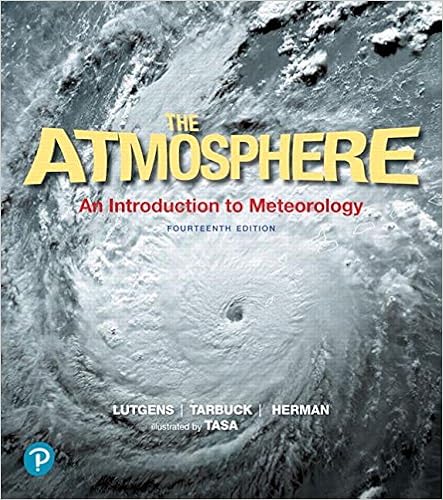
The Atmosphere: An Introduction to Meteorology, 14th Edition
Authors: Frederick K. Lutgens, Edward J. Tarbuck, Redina Herman, and Dennis G. Tasa
Publisher: Prentice Hall
Copyright: 2019
Print ISBN-13: 978-0134790466
Print ISBN-10: 0134790464
eText ISBN: 9780134801001 / 0134801008
Table of Contents
- Introduction to the Atmosphere
- Heating Earth's Surface and Atmosphere
- Temperature
- Moisture and Atmospheric Stability
- Forms of Condensation and Precipitation
- Air Pressure and Winds
- Circulation of the Atmosphere
- Air Masses
- Weather Patterns
- Thunderstorms and Tornadoes
- Hurricanes
Course Description and Learning Outcomes
Catalog Course Description
This descriptive course in elementary meteorology introduces students to weather analysis and forecasting. Topics include temperature, pressure, wind, radiation, clouds, precipitation, synoptic weather charts, air masses, high- and low-pressure systems, frontal systems, thunderstorms, weather forecasting, and local weather.
Learning Outcomes
By the end of the semester, students should be able to understand basic atmospheric processes, interpret common weather patterns, explain why weather changes, and develop a basic weather forecast.
Homework
Homework questions may be assigned from each chapter and may not always be collected. Students who regularly complete the readings and assignments generally perform better in the course.
How to Succeed in PHY 116
- Read each chapter before class whenever possible.
- Take detailed notes from the textbook, videos, online notes, and classroom discussion.
- Rewrite important concepts in your own words so that you understand them.
- Ask questions before an exam rather than waiting until after it.
- Contact Professor Hoffman promptly whenever course material is unclear.
- Check your Farmingdale email regularly.
Course Topics
1. Climate and the Atmosphere
- Nature and origin of the atmosphere
- Atmospheric composition
- Layers of the atmosphere
2. Heat and Temperature
- Radiation budget
- Variability of insolation
- Air-temperature measurement
- Horizontal and vertical temperature distribution
3. Atmospheric Moisture
- Water vapor and humidity
- Changes of state
- Cloud formation and classification
- Precipitation processes, forms, and distribution
4. Motion in the Atmosphere
- Atmospheric pressure
- Vertical and horizontal pressure relationships
- Pressure and wind
- Global circulation, upper-level waves, and jet streams
- Monsoons and ocean circulation
5. Weather Disturbances
- Air masses and source regions
- Atmospheric stability and instability
- Fronts, cyclones, and anticyclones
- Tropical storms and hurricanes
- Thunderstorms, tornadoes, and waterspouts
- Weather maps and regional patterns
Withdrawal from the Course
Students considering withdrawal should speak with Professor Hoffman first so that possible solutions can be discussed. The listed last day to withdraw is October 30th, 2026.
Professor Hoffman's Perspective
Meteorology can be fun and exciting. Weather affects everyone, from winter snowstorms to summer thunderstorms. Understanding the atmosphere is challenging, but this class provides a foundation for interpreting the weather around us.
Professor Hoffman brings more than 30 years of meteorological experience, including television meteorology in the Northeast, and welcomes student questions and suggestions for topics to explore.
Questions?
Email Professor Hoffman:
Phone: 516-393-1774