


Test 1 Information
Chapters 1 and 2 • Test 1: September 16, 2026
Read both chapters in the textbook and review the Smart Figures listed below.
Chapter Videos
Earth's Motions and the Seasons
The spinning of Earth on its axis.
Earth's movement in its orbit around the Sun.
Why Solar Energy Changes During the Year
- The seasonal change in the angle at which the Sun's rays strike Earth's surface.
- The changing length of daylight.
Important Seasonal Dates
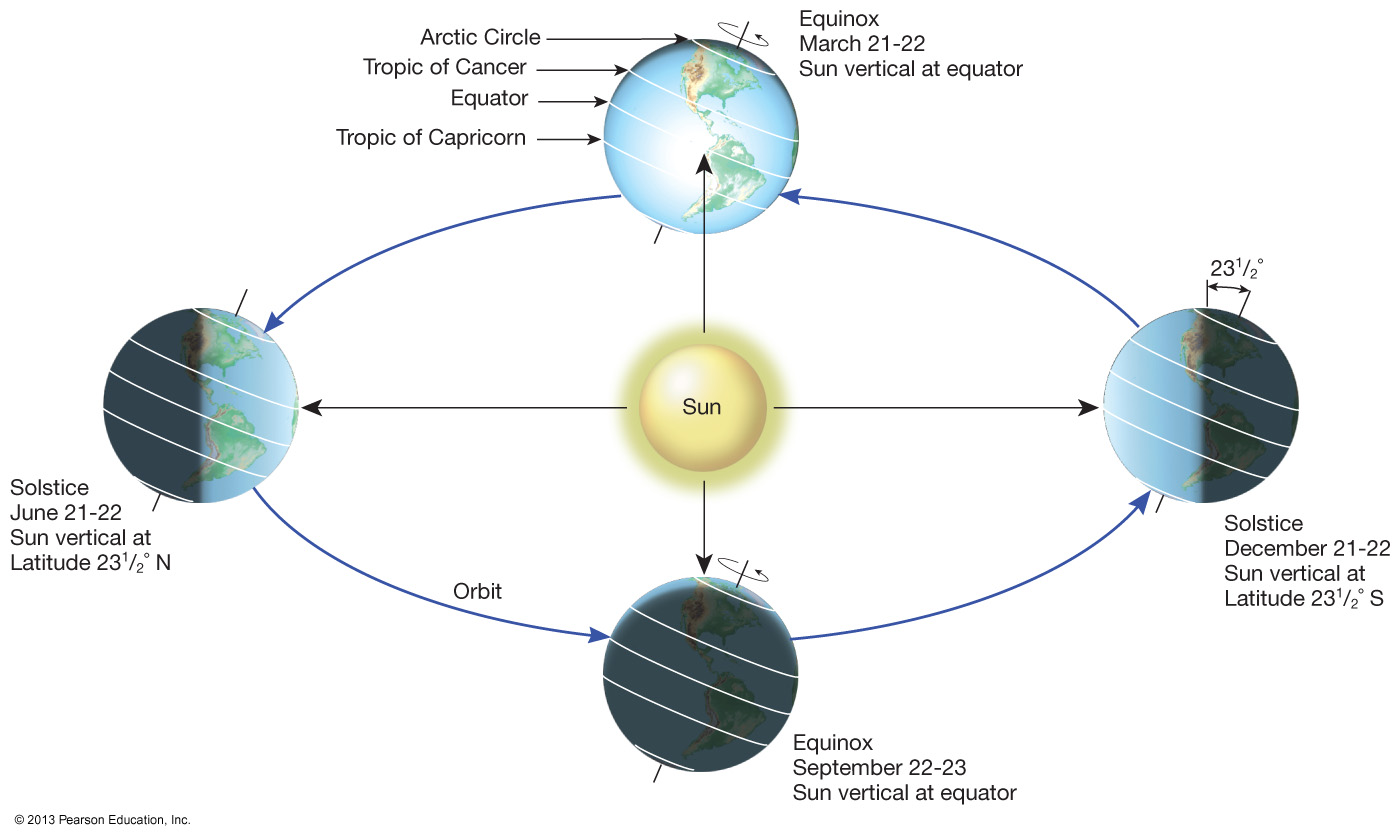
- Summer solstice: June 20–22. The Sun's vertical rays strike 23.5° north latitude, the Tropic of Cancer.
- Winter solstice: December 20–22. The Sun's vertical rays strike 23.5° south latitude, the Tropic of Capricorn.
- Autumnal equinox: September 21–23. The Sun's vertical rays strike the equator.
- Vernal equinox: March 19–22. The Sun's vertical rays strike the equator.
Important reading: Pages 29–34. Review Smart Figures 2.2, 2.5, 2.6, and 2.9.
Season and Sun-Ray Diagrams
Study Earth's tilt, the location of the direct rays of the Sun, and the circle of illumination.


Understanding Noon Sun Angle
Use this formula:
Noon Sun Angle = 90° − the latitude difference between your location and the subsolar point.
June 21 in Farmingdale
Farmingdale is approximately 40°N. The Sun is directly overhead at 23.5°N.
40° − 23.5° = 16.5°
90° − 16.5° = 73.5°
This is approximately the maximum noon Sun altitude in Farmingdale.
December 21 in Farmingdale
Farmingdale is approximately 40°N. The Sun is directly overhead at 23.5°S.
40° + 23.5° = 63.5°
90° − 63.5° = 26.5°
This is approximately the minimum noon Sun altitude in Farmingdale.
Memory hint: Cancer comes before Capricorn.
Important Latitude Lines and Daylight
Seasonal Daylight on Long Island
- Vernal equinox: about 12 hours
- Summer solstice: about 15 hours
- Autumnal equinox: about 12 hours
- Winter solstice: about 9 hours
Latitude Lines
- 66.5°N: Arctic Circle
- 23.5°N: Tropic of Cancer
- 0°: Equator
- 23.5°S: Tropic of Capricorn
- 66.5°S: Antarctic Circle
Daylight Saving Time
For 2026, daylight saving time begins Sunday, March 8, at 2 a.m. and ends Sunday, November 1, at 2 a.m.
Clocks move forward one hour in March, from 2 a.m. to 3 a.m.
Monthly Islip Almanacs
Monthly almanacs include climate averages, records, sunrise and sunset times, precipitation, and snowfall information.
2026 Seasons
| Season | Astronomical Start | Astronomical End | Meteorological Start | Meteorological End |
|---|---|---|---|---|
| Spring | March 20 | June 20 | March 1 | May 31 |
| Summer | June 21 | September 21 | June 1 | August 31 |
| Fall | September 22 | December 20 | September 1 | November 30 |
| Winter | December 21 | March 19, 2027 | December 1 | February 28, 2027 |
Why the Seasons Change
The seasons are caused by Earth's 23.5° axial tilt and its revolution around the Sun—not by Earth's distance from the Sun.
- Vernal equinox: The Sun crosses the celestial equator moving northward. Day and night are approximately equal.
- Summer solstice: The Northern Hemisphere receives its greatest amount of daylight, and the noon Sun reaches its highest position.
- Autumnal equinox: The Sun crosses the celestial equator moving southward. Day and night are approximately equal.
- Winter solstice: The Northern Hemisphere receives its least amount of daylight, and the noon Sun reaches its lowest position.
Energy, Heat, and Temperature
Energy of motion.
Stored energy with the ability to do work.
The transfer of energy caused by a temperature difference.
Temperature measures the average kinetic energy of the particles in a substance.
Read pages 35–38 and know the difference between heat and temperature.
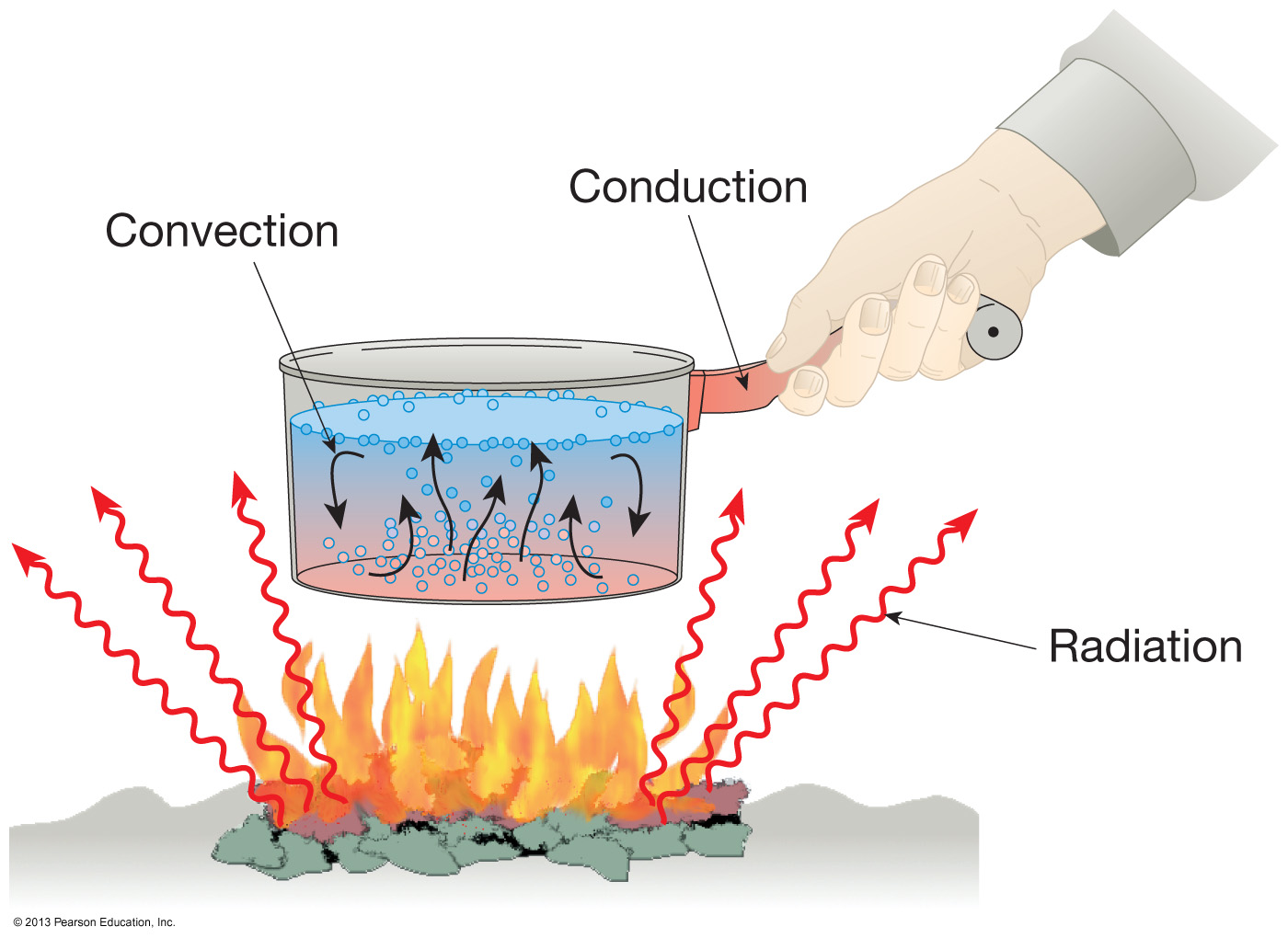
Three Methods of Heat Transfer
Heat transfer through matter by molecular contact.
Heat transfer by the movement or circulation of a fluid.
Energy transfer by electromagnetic waves. This is how solar energy reaches Earth.
Electromagnetic Radiation
Electromagnetic radiation travels through space at approximately 300,000 kilometers per second. Shorter wavelengths carry more energy. Visible light ranges from about 0.4 micrometer for violet light to 0.7 micrometer for red light.
Basic Laws of Radiation
- All objects emit radiant energy.
- Hotter objects radiate more total energy per unit area than colder objects.
- The hotter an object is, the shorter the wavelength of its maximum radiation.
- Good absorbers of radiation are also good emitters.
Radiation, Scattering, and Albedo

Wavelengths

Incoming Solar Radiation

Shortwave and Longwave Radiation

Scattering

Why Sunsets Look Red

Blue Sky and Red Sunset

Albedo
Albedo is the fraction of incoming radiation reflected by a surface. Fresh snow has a very high albedo.
Important reading: Pages 42–48. Review Smart Figures 2.15, 2.16, 2.17, and 2.18.
Earth's Heat Budget and Greenhouse Effect
About half of the solar energy reaching the top of the atmosphere reaches Earth's surface. Roughly 30% is reflected back to space, while about 20% is absorbed by clouds and atmospheric gases.
Earth reradiates absorbed energy as longwave infrared radiation. Water vapor and carbon dioxide absorb much of this terrestrial radiation, helping warm the lower atmosphere. This process is called the greenhouse effect.
The atmosphere is heated primarily from below. The average temperature decrease with height in the troposphere is about 6.5°C per kilometer, known as the normal lapse rate.
Earth's average temperature remains relatively stable because incoming solar radiation and outgoing terrestrial radiation are approximately balanced over time. This balance is called Earth's heat budget.
Test 1 Review
Study Chapters 1 and 2 and read both textbook chapters.
- Layers of the atmosphere and what makes each layer different
- Weather versus climate
- How almanacs describe local climate
- Why Earth has seasons
- Tropic of Cancer, Equator, and Tropic of Capricorn
- Sun angle and length of daylight
- Conduction, convection, and radiation
- The difference between heat and temperature
- Why the sky appears blue and sunsets appear red
- Albedo and wavelength
Questions? Email richard.hoffman\@farmingdale.edu